

— by Ernie Beck CTS-D and Matt LeFeber CTS
As we optimistically approach a post-pandemic world, some corporate and university campuses will consider responsive and adaptive facilities as key to a successful future. Many are familiar with the promise of intelligent buildings to deliver the triple bottom line of energy savings, operational efficiency, and increased user satisfaction. But some may be unclear about how to get started with these new systems and capabilities.
One of our midwestern university clients is currently building an entirely new campus with the goal of making “the campus of the future.” They established early in design their vision for intelligent building technologies. It was intrinsically understood that leveraging technology would enable them to build more energy efficient facilities with a user journey that is personal, safe, engaging, and unique.
The university had a clear vision of their goals but needed to better understand exactly how to best execute them. Our discovery phase explored many different approaches and technology systems. During this process, it became clear that a building made up of siloed “intelligent” systems did not achieve the goal of creating an “intelligent building.” To ensure we were creating facilities that were truly interconnected and intelligent, we considered two topologies, represented in Figure 1 and Figure 2 below.
Hub-and-Spoke Strategy
The hub-and-spoke strategy (Figure 1) is a common approach based around an intelligent building management system (iBMS). The iBMS is a central “hub” customized to address the requirements developed with the project stakeholders. Other buildings systems, or “spokes,” communicate to the iBMS via protocols such as BACnet, KNX, TCP/IP, XML, HTTP, and so on. In some instances, middleware or application programming interfaces (APIs) will be required where nonstandard integrations exist.
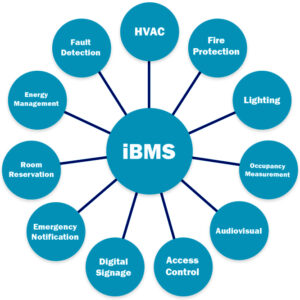
Integrating multiple systems into a single management platform allows data visibility from a central user interface and enhances real-time decision-making processes to create a better-performing building. Advanced iBMS systems have native mobile applications to allow users to remotely manage systems from a smartphone or tablet.
This strategy also streamlines the implementation of the various intelligent concepts of operations between systems. For context, concepts of operations exist when two or more connected systems automate based on a condition triggered by one of the connected systems. A common example is a traditional BMS system where the HVAC, fire protection, and access control systems are connected for life-safety purposes. A well-planned iBMS could also integrate lighting, people counting, and energy management to yield substantive savings and efficiencies. The hub-and-spoke strategy relies on a master systems integrator (MSI) to install and commission these various integrations, simplifying the coordination among several different trade contractors.
This strategy is not without its potential drawbacks. More complex BMS systems require higher-skilled operators who are savvy in both the building systems and the software. Owners must consider if they have the skillsets in-house to manage a complex iBMS and should be mindful of additional cost licensing for various subsystems that may be required. All of these should be factored into the operating expense (OpEx) and ROI calculations.
Another drawback is that traditional BMS systems have historically fallen short of the processing power needed to trend large amounts of data efficiently, as the system may capture thousands of data points every five minutes, for example. This is where services such as third-party data analytics, monitoring-based commissioning (MBCx), and fault detection and diagnostics (FDD) services may be recommended to augment a more traditional BMS approach.
Hub and spoke requires a much heavier involvement with the BMS controls vendor, creating a perceived single point of failure. If a software patch for the BMS system is updated, will it have a negative downstream effect on the other connected systems? More importantly, does this approach limit the choices available to the university when it comes to selecting vendors?
As we reviewed this strategy with the owner, their trepidation was clear. Together we explored another common intelligent building strategy: meshed systems.
Meshed Systems Strategy
In the meshed systems model (Figure 2), each building system is specified with their own centralized management console and edge-device intelligence, while the BMS system is focused on more traditional control functions. By using common communication protocols, middleware, and APIs, building systems such as lighting, security, audiovisual (AV), emergency notification, signage, and people counting may be integrated directly with each other as needed for sharing data collection, alarms, and intelligent sequences of operation.
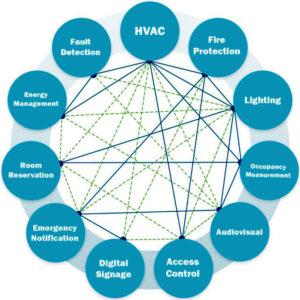
The distributed architecture allows owners to start small and grow their systems as needed by utilizing connections between systems that often require little custom development and licensing costs. For example, in the hub-and-spoke strategy, having the AV systems communicate with the lighting would require interfacing the iBMS and thus require coordination from the BMS contractor, lighting contractor, and AV programmer. With a meshed systems strategy, it is cleaner for the AV programmer to communicate directly with a lighting control system, bypassing the BMS entirely. The result is the same for the occupant, but the implementation method is simplified.
The primary drawback of this strategy involves the coordination of multiple different design disciplines and contractors. Historically, many of these systems have been designed in silos, which is antithetical to the purpose of an intelligent building. Careful coordination is required between the various project designers, engineers, and consultants to ensure the systems can integrate as outlined with the owner. If this coordination is missed or incomplete, it could lead to delays, change orders, and finger-pointing between contractors during installation and commissioning. Clearly, the meshed systems strategy requires more thorough planning.
Selecting the Right Approach
In the end, the meshed systems strategy resonated with this particular owner for a few key reasons: It complements their existing and familiar design process, allows for open-source specifications, and does not lock them into a single BMS controls vendor for the life cycle of the equipment.
The approaches outlined above are simplified representations of complex topics but are offered as a starting point for conversations and subsequent design development. Your specific intelligent buildings technology (IBT) approach may include variations of both strategies operating simultaneously. Alternatively, owners and facilities managers may choose to start only with providing more robust IT infrastructure ready to support intelligent buildings in the future. Whichever strategy is selected, objective due diligence around complexity, cost/ROI metrics, data analysis, and network security is always recommended.
Many professionals believe that IBTs will be more relevant than ever as we approach a post-pandemic world. Identifying the optimal system strategy will be key to success.
Senior Consultant Ernie Beck and Principal Consultant Matthew LeFeber are technology consultants with NV5 Engineering & Technology (formerly Sextant Group) and located in Washington DC, and Omaha NE, respectively. A slightly different version of this article was initially published in APPA’s Facilities Manager magazine.
Use the form below and share your thoughts with us about Intelligent Building Topology, meshed systems, and the evolution of IBT.