

Since ancient times, humans have always been looking for a way to store energy or construct some form of what is now called ‘batteries’. The oldest battery discovered to date is the Baghdad (or Parthian) battery, which we believe to be 2,000 years old. Although the device could only produce 1 to 2 volts of electricity and not all scientists accepted it as a source of energy, it showed the human’s desire to be in control of their own energy…or as grandmas simply put it, “you always have to save for the rainy days.”
Saving for the rainy days can be literal in some cases. For example, the sun doesn’t always shine for solar panels, or the wind doesn’t always blow in the case of wind turbines. While the challenges of how to efficiently store energy can range widely depending on the application with each application warranting its own in-depth discussion, this article will specifically focus on the storage of thermal energy for use in comfort cooling or industrial process cooling. In this case, the “rainy days” would be the times when electricity demand is high (and expensive) and may even come with a penalty when consumption exceeds a certain amount.
What many people do not realize is that their electricity rates do not typically stay at one constant $/kWh throughout the day. Electricity follows the supply and demand curve. During the day when everybody uses it and when the outdoor temperature hits its peak (high demand), it costs more per kWh. At night when most people are sleeping and the outdoor ambience is more comfortable (low demand), it costs less per kWh. At some points, you must have been encouraged by your electric utility companies to run your high load appliances such as dishwashers, washing machines, or dryers, during the night. Doing so will not only lower your electricity bills, but it also relieves the load on the electric grid during the peak demand of the day. Everyone wants to save on their energy bills, but why should they care about the electric grid that is beyond the scope of their house or business? When the winter storm, “Uri” hit a large part of Texas in February 2021, the temperature dropped so low that every house and business needed to blast their heaters, creating an unprecedented stress on the electric grid that was not winterized. As a result, ERCOT (Electric Reliability Council of Texas) started implementing rolling blackouts to conserve energy. This resulted in people losing power for more than a week (the author was one of the luckier ones who only lost power for 3 days). This is an extreme example but goes to show that shifting energy usage to ease the electric grid is a common goal that every individual and business should take accountability for.
Thermal Energy Storage (TES): What it is, To TES or Not to TES
The idea of a Thermal Energy Storage tank (TES) is quite simple. At night, when electricity is less expensive and the grid is not overloaded, chilled water or ice is produced and stored in a tank. During the day, when electricity costs more and the grid is stretched thin, the stored chilled water or ice is used to serve the loads (HVAC or process) in lieu of having to use a cooling equipment such as an electric chiller. Some utility providers even offer financial incentives such as specialized rates, rebates, and high peak demand charges in hopes of encouraging customers to shift more electricity consumptions to the nights (off-peak periods). In general, a TES tank should be incorporated into the design when any of the following factors applies:
- The electric utility rate structure includes high demand changes, a large difference between on-peak and off-peak rates, or special rebates for TES installations or peak shaving. Sometimes the cost of producing chilled water at night (off-peak pricing) can be half the cost of producing the same amount of chilled water during the day (on-peak pricing).
- A large district cooling system with great variations of loads. During the day, the TES tank can be calibrated to either fully meet the load or operate partially to help the chillers operate at their “sweet spot”. At night, ideally the load profile will be low enough that some chillers operate to serve the load and the remaining chillers operate to fully charge the TES tank.
- When the project’s priority is to have thermal and electric balance, such as when a Combined Heat and Power System is operated in tandem with the cooling plant.
- When renewable solutions are part of the design. A TES tank can offset the impact of the intermittency of wind and solar.
- When redundancy is desired, such as in the event of a chiller failure, loss of make-up water, or even emergency fire suppression.
In any application, an in-depth total cost of ownership is strongly recommended to evaluate the true cost and benefits of a TES tank. A system with TES will always have higher capital cost compared to a traditional non-storage system. However, with the right design that complements with the utility rate structure, it will just be a few years before the TES tank starts paying off for itself and generating savings for many years to come.

Design Strategies Overview
- Cooling Media
Once the designer determines that it is beneficial to incorporate TES into the design, the next task would be to select which storage media is most suitable for the project. Ice and chilled water storage are the two most common and reliable media. Each approach has its pros and cons and must be evaluated carefully by the designer before selecting the most appropriate solutions for the project. Remember, most of the times there is no right or wrong. It can simply come down to what works best. Generally, chilled water is simpler in the sense that it can be charged and discharged at the same temperatures as the chiller. Since there is no need to produce ice making temperatures, more specialized machines are not required. If ice is selected, thoughtful considerations must be exercised to ensure the overall efficiency of the plant is not degraded because of the additional energy required to drive the phase change of water to ice. The main benefit of ice is the much smaller tank sizes and shorter installation times.
- Configuration
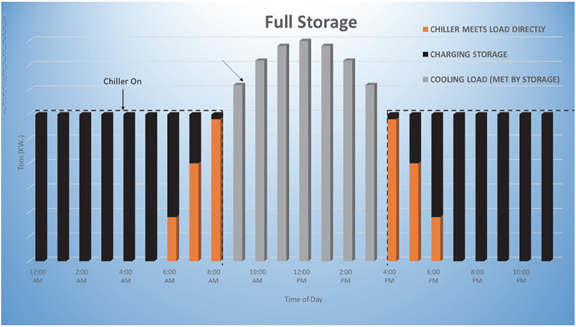
There are three fundamental ways to size a TES. The first is full load shed, which sizes the tank for the avoidance of any chilled water production during the target pricing period. Full load shed requires the largest physical tank and the most chiller capacity of any TES scenario.
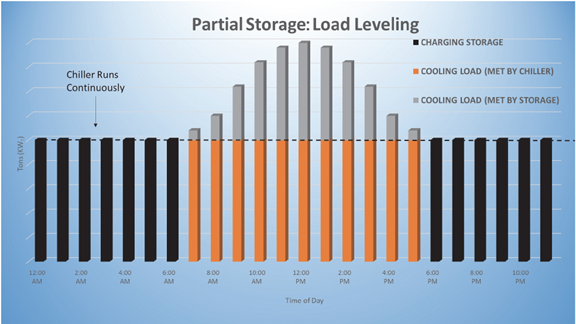
The next sizing option is known as ‘load leveling’, where no consideration is given to avoiding chilled water production during a specific window of time. Instead, the objective is to slightly downsize a plant’s total capacity and use the TES to meet peak demand windows. This enables the chillers to operate at a constant production value all day long.
The third sizing option falls between the two just mentioned. It is known as ‘partial load shedding’ or ‘demand limiting’. In this case, the tank is optimized to minimize the use of chillers during a specified period, but not to the same degree as the full storage option. This option is would be selected to optimize energy savings relative to the capital cost of the TES installation. Partial load shed sizing yields a smaller tank than full load shed while potentially decreasing installed chiller capacity.
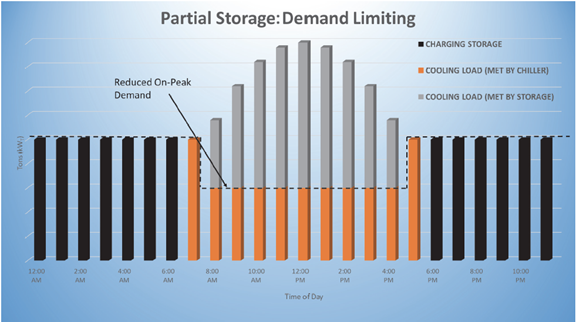
(Courtesy CALMAC CORP)
- Operating Modes
The five most common TES operating modes are summarized below. Some systems may use all five modes, some may use fewer. Others only operate under only two modes: daytime and nighttime. The TES designer shall determine the best operating strategies for each project.
- Charging Storage – Operating cooling equipment to remove heat from storage.
- Charging storage while meeting loads – Operating cooling equipment to remove heat from storage and meet loads.
- Meeting loads from storage only – Discharging (adding heat to) storage to meet loads without operating cooling equipment.
- Meeting loads from storage and direct equipment operation – Discharging (adding heat to) storage and operating cooling equipment to meet loads.
- Meeting loads from direct equipment operation only – Operating cooling equipment to meet loads (no fluid flow to or from storage).
- Controls Strategies
There are multiple ways to optimize the operations of TES systems. Some systems utilize complex algorithms that will regulate the level of charge and discharge based on a prediction of the load for the following day. The algorithms also look at other factors such as outside air ambience and the efficiency curves of each mechanical equipment. With many variables, this strategy can get complicated very quickly, but can potentially be calibrated over time to yield optimal savings. On the other hand, a more simplified approach would have the TES tank charge and discharge at a pre-determined, constant rate. For this strategy to work, the designer must pay close attention to the load profile as well as the efficiency curves of the chillers. Because there are no algorithms to optimize the operations in real time, all optimizations must already be considered during the design phase. However, the same can be said for a more sophisticated controls scheme: the designer must carefully evaluate different charge and discharge scenarios and make sure that the sequences would be able to, first and foremost, work, before they can be optimized by the algorithms.
Conclusion
One size does not fit all. Not every project will benefit from having a TES system. However, if projects that are a perfect fit for TES but not designed with TES in mind, the consequences can mean millions of dollars of lost savings, an imbalanced thermal and electrical system, or even more importantly, an overloaded and less resilient electric grid.
Additional Resources
This article is intended to provide a 10,000-foot overview of TES systems and their most common uses. Readers who are interested in learning more about TES should consult the following resources:
- ASHRAE Design Guide for Cool Thermal Storage – 2nd Edition
- ASHRAE HVAC Systems and Equipment
- ASHRAE HVAC Applications