
By Michael Frank, Associate Principal with NV5 in Raleigh, NC
Previously, we explored the topic of revitalizing underused spaces by transforming them into vibrant hubs that support gaming, community building, and educational opportunities. This growing movement blends technology, curriculum development, and immersive design to create environments that prepare students for careers in the expanding world of esports and related industries.

If one needed more justification for these exciting spaces, this article serves as a follow-up, focusing on how to leverage esports spaces for collaborative and interdisciplinary learning for programs outside, but adjacent to, esports.
Esports, or electronic sports, have transcended the realm of casual gaming to become a global phenomenon, featuring millions of players, professional leagues, and major media coverage. The United States is increasingly integrating scholastic esports programs into school curricula, offering skill development and career opportunities. Pew Research Center reports 70% of college students engage in gaming, with most starting in elementary school. College campuses host active esports communities, including over 300 varsity-level programs recognized by the National Association of Colleges and Employers (NACE), which enable smaller schools to compete nationally. As student interest grows, colleges are rapidly investing in esports facilities. Even better, these spaces can extend past esports and bring disparate programs together.
Thinking Big
An esports facility offers a home to more than the obvious residents, such as esports teams and clubs, and to academic programs such as game design, graphic design, computer

science, and networking. While those groups have an obvious and immediate need for such a space, institutions are now exploring broader academic applications to maximize utilization, justify start-up and operational costs, and create richer cross-campus collaboration. By thinking beyond traditional boundaries, colleges and universities are discovering that an esports environment be capable of serving as a dynamic, interdisciplinary learning hub. For example, human performance programs can use gameplay analytics to study reaction time, fatigue, and cognitive load, while statistics students analyze accuracy trends, win/loss probabilities, and predictive performance models. Communications, journalism, and broadcast production programs gain a real-world studio for live event coverage, commentary, and multimedia storytelling. Medical and health sciences examine ergonomics, stress responses, and repetitive‑strain injuries, and mathematics students are able to work with authentic, high-volume datasets that bring abstract concepts to life. The opportunities extend to programs such as business, marketing, psychology, sociology, and technical production, making the esports facility a versatile resource that supports experiential learning across the institution. When leveraged creatively, it becomes a campus-wide innovation engine rather than a single-purpose gaming space.
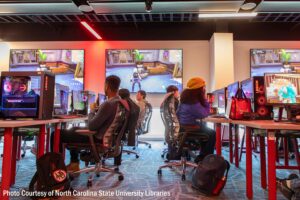
A well-designed esports program can catalyze academic engagement across an entire institution. Insights show that when a university invests in a robust esports facility, it creates far more than a competitive gaming space, it builds a multidisciplinary training ground that prepares students for emerging careers in media, technology, communication, and human performance. An on-campus esports initiative offers firsthand experience in digital storytelling, live event production, analytics, and audience engagement, giving students a direct pathway from classroom learning to real-world applications. For students who already have a passion for gaming, this becomes a powerful motivator, and they are able to see how their academic studies translate into professional opportunities in broadcasting, journalism, marketing, sports management, and technical production. As a result, the esports program becomes a compelling recruitment asset, highlighting the university’s commitment to innovation, experiential learning, and industry-aligned skill development. Institutions that embrace this model position themselves as forward-thinking destinations for students seeking both academic rigor and advanced career preparation.
Virtual Reality

Virtual Reality (VR) is rapidly emerging as a transformative force within the esports ecosystem, adding new dimensions to gameplay, competition, and spectator engagement. By immersing players in fully interactive digital environments, whether through headsets, omnidirectional treadmills, or virtual football and basketball simulations, VR-based esports demand a blend of physical dexterity, spatial awareness, and rapid decision-making that goes far beyond traditional gaming. This evolution expands the types of competitions or programs institutions can offer and attracts a broader audience, including students interested in the intersection of physical activity, immersive technology, and digital competition.
Like traditional esports facilities, VR-integrated spaces enable rich interdisciplinary collaboration. Students in game development, design, and computer science can experiment with VR content creation, simulation design, and interactive storytelling. Health sciences programs can study ergonomics, posture, injury prevention, and the physiological demands of VR-enhanced gameplay or immerse their students in real-world virtual scenarios. Communications, journalism, and broadcast production students gain direct experience with the unique challenges of capturing and producing VR-based events, from 360-degree camera work to immersive audience engagement strategies. As VR technology becomes more accessible and more deeply embedded in industry practice, its role within scholastic esports will only continue to grow, offering students state-of-the-art experiences that seamlessly connect academic theory with direct application.
Level Complete: The Ultimate Takeaway
In short, an esports program and its associated facilities serve far more than recreational or competitive gaming purposes. They become dynamic, real-world laboratories that support a wide range of academic programs, blending classroom learning with innovative technology in ways that resonate with today’s students. When institutions embrace this broader vision, esports become a powerful engine for innovation, collaboration, and experiential learning across the entire campus.
Keep an eye out for the next article in our esports series, where we will continue exploring creative ways educational institutions can leverage technology and innovation to enrich student experiences and address spatial considerations. More insights and practical strategies are on the way as we dive deeper into the rapidly evolving world of scholastic esports.
Michael Frank is an associate principal with NV5 in Raleigh, NC with over 25 years of experience in the technology industry.