
By Roman DeSimone, CTS
Higher education has never leaned more heavily on technology than it does today. Hybrid classrooms, lecture capture systems, and digital collaboration tools are no longer luxuries. They are now expectations. Campuses are also expected to provide seamless Wi-Fi, networked security, and digital signage that ties the entire institution together.
Despite generous budgets and talented teams, projects often encounter setbacks. Surprisingly, the problems are rarely about the quality of the hardware or software. Instead, the biggest roadblocks stem from whether technology is coordinated effectively within the broader project scope.
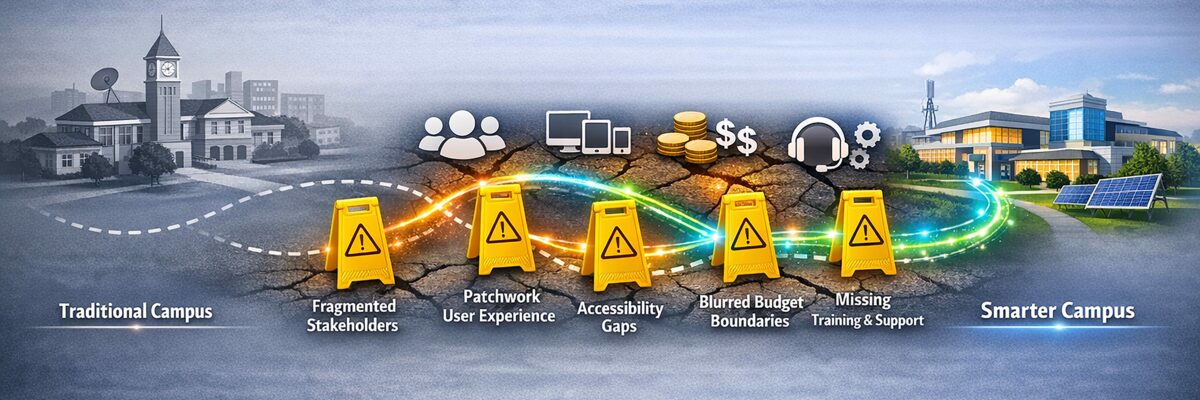
These five recurring obstacles can derail even the best-planned initiatives. The good news? Each obstacle can be anticipated and resolved with thoughtful planning before it spirals into costly change orders, project delays, or frustrating user experiences.
Obstacle #1: Fragmented Stakeholder Involvement
Universities often approach technology in phases: Facilities oversees building layout, IT focuses on the backbone network, and AV designers are brought in later for classrooms. Unfortunately, this staggered involvement creates gaps that are difficult to close once construction is underway. For instance, a lecture hall may be designed without considering recent AV standards changes or Telecom closets might be undersized because the team did not know that the security headend equipment needed a home as well.
In the absence of early coordination, Accessibility and Security teams tend to be looped in after the drawings are issued. At that point, it’s difficult to integrate features like door access control or assistive listening systems without costly redesign.
Overcome the Obstacle: Before schematic design is finalized, teams should hold a multidisciplinary kickoff session that brings together representatives from IT, AV, Facilities, Security, Accessibility, and faculty. Involving all these stakeholders at the same time helps surface issues early, reduces rework, and ensures technology is thoughtfully integrated into the building rather than added later as an afterthought. It is not only important to consider this coordination early, but also often throughout the project lifecycle to ensure feedback is captured from all key stakeholders.
Obstacle #2: A Patchwork of User Experiences
Imagine a professor who teaches in three different classrooms on campus. In one space, they’re greeted by a touchscreen; in another, a push-button panel; and in the third, a laptop dongle and a different password. These inconsistencies waste valuable class time, frustrate faculty, and overwhelm the IT help desk agents receiving frantic calls just before class begins.
Supporting multiple control platforms also strains IT resources, requiring varied training, stocking of more spare parts, and managing different firmware cycles. Over time, this leads to inefficiency and higher costs.
Overcome the Obstacle: Codify a campus technology standards guide that creates consistency without enforcing a cookie-cutter approach. For example, all classrooms might use the same type of control panel and button layout, while lecture halls can scale up with more advanced features. Predictable interfaces empower faculty to focus on teaching, not troubleshooting.
Obstacle #3: Accessibility Not Considered
When teams address accessibility late in the design process, it can result in awkward retrofits and compliance risks. Worse, it sends a message of exclusion to students who rely on these features. It also leaves students who rely on these features feeling marginalized.
The missed opportunity is that accessibility technology benefits everyone. Live captioning supports non-native speakers and students in noisy environments. Assisted Listening Systems improve sound clarity for all. Delayed accessibility leads to the project losing the chance to design these features holistically.
Overcome the Obstacle: Treat inclusive design as a requirement. Consider accessibility services at the same time as AV and IT, with compliance checkpoints built into every design milestone. Early planning creates equitable experiences that are seamless rather than segregated.
Obstacle #4: Blurred Budget Boundaries
Technology costs often fall into gray areas. Facilities may assume IT is covering pathways and conduits, IT may expect AV to provide PoE switches for cameras, and the AV team may rely on the furniture budget for room lecterns. This confusion leads to double-counting, missed items, and scope gaps.
Overcome the Obstacle: Establish scope and responsibilities early in the design phase. Clearly assign ownership for racks, cabling, network gear, displays, microphones, cameras, access control, and other system components. When everyone understands what they own, budgets align more accurately, and the bidding process runs smoothly.
Obstacle #5: Overlooking Training and Service Agreements
Launching a new facility with modern technology is only the beginning. Far too often, projects succeed on opening day but without structured training and support, systems quickly fall into disuse. Faculty may avoid features they don’t understand or default to workarounds, and unresolved technical issues can escalate into major disruptions.
Training and service are not optional extras but essential parts of a sustainable technology environment. Faculty need the confidence to operate systems independently, while IT teams need a clear escalation path when issues arise. Without that support structure in place, frustration builds, adoption suffers, and the institution’s technology investment is less likely to deliver its full value.
Overcome the Obstacle: Build training and service agreements directly into the project scope. Schedule faculty and staff workshops before occupancy and ensure that post-installation support contracts specify clear response times and responsibilities. Institutions that prioritize training and service protect both their investment and the learning experience.
Closing Thoughts
Higher education projects rarely fail because of the technology itself. Instead, breakdowns in coordination such as fragmented teams, inconsistent experiences, overlooked accessibility, unclear scope and budget, and missing support plans are the real culprits.
The good news is that intentional planning can eliminate each of these obstacles. Engaging stakeholders early, setting clear standards, embedding inclusivity, clarifying responsibilities, and building structured training and service agreements transforms projects from patchwork solutions into cohesive digital ecosystems.
Universities that take this approach don’t just install technology; they build future-ready campuses that elevate teaching, learning, and collaboration for years to come. In an environment where technology increasingly defines the student and faculty experience, preparation makes all the difference.
Roman DeSimone is a Project Consultant in Philadelphia, PA with 15 years of experience.