
By James Cottrell, INCE BD. CERT.
Walk through any design expo, browse a workplace furniture catalog, or scroll through architectural inspiration boards, and you’ll quickly notice one material showing up everywhere: PET Acoustic Panels.
PET acoustic panels are sound-absorbing wall and ceiling treatments made from recycled polyethylene terephthalate (PET) plastic fibers. Their popularity is easy to understand. PET panels offer a compelling combination of aesthetics, sustainability, durability, and acoustical performance. They’re available in an enormous variety of colors, textures, profiles, and custom-cut shapes. Unlike traditional fabric-wrapped panels, many PET products don’t require an additional fabric finish, making them easier to customize and increasing their potential as a design feature.
But there’s one important reality that often gets overlooked: Not all acoustic panels perform equally.
For architects looking to balance aesthetics, sustainability, and acoustical performance, it’s important to understand both the strengths and limitations of PET panels.
Why Have PET Panels Become So Popular?
PET acoustic panels are typically manufactured from recycled plastic, often including post-consumer water bottles and other recycled materials. For clients pursuing sustainability goals, this is a major advantage.
In addition to their environmental appeal, PET panels offer several practical benefits:
- Available in hundreds of colors and finishes
- Can be CNC-cut into custom geometric patterns
- Can function as wall panels, ceiling baffles, clouds, screens, and decorative features
- Relatively durable and resistant to wear
- Often easier to clean than traditional fabric-wrapped products
- Provide acoustical treatment without requiring an additional fabric layer, which can decrease installation time wall device coordination
The result is a product that helps architects integrate acoustics into a space’s visual language rather than treating it as an afterthought. For many projects, that’s a significant win.
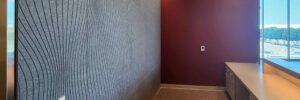
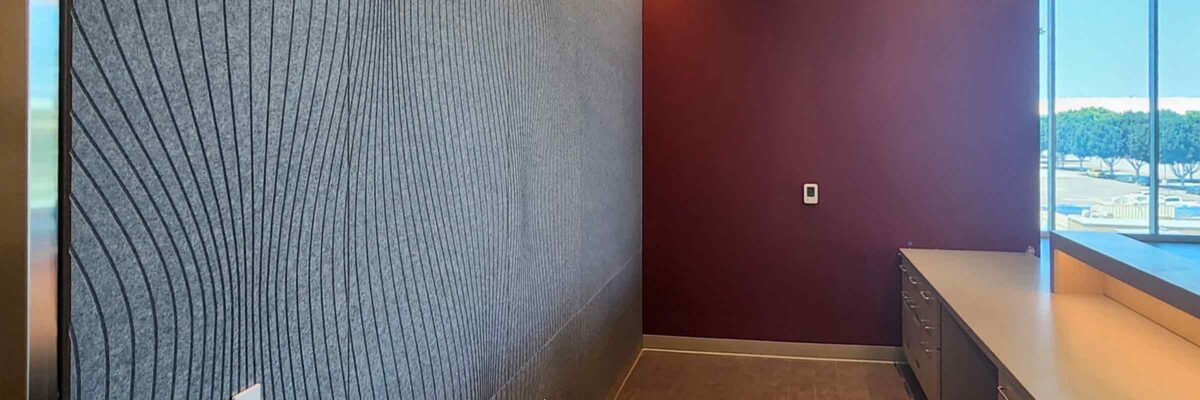
PET Panels in construction, at a reception desk, were selected for their aesthetic design options and durability in a public space, with an otherwise absorptive ACT ceiling.
How Do They Perform?
Standard PET panels are often sold at 1/4” or 1/2”, which results in NRC (Noise Reduction Coefficient) ratings between NRC 0.25 and NRC 0.40.
While these panels provide measurable absorption, they are often lower than what designers may be accustomed to from traditional fabric-wrapped fiberglass panels, which may have an NRC of 0.80. The challenge arises when the absorptive performance is assumed and not analyzed properly.
This lower NRC value indicates these panels are not as optimized for the frequencies of human speech, compared to what a traditional panel with NRC of 0.80 does. That’s a meaningful difference when controlling reverberation in conference rooms, classrooms, offices, hospitality spaces, or other acoustically sensitive environments.
Can We Make Them Perform Better?
Of Course! The two ways to make traditional PET panels perform more closely to traditional Fiberglass panels are to increase their thickness or to mount them furred out from the wall with an airspace.
Thickness Matters
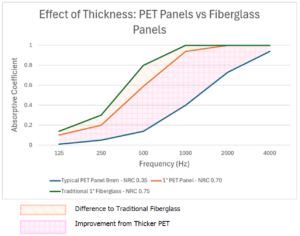
Just as thicker insulation provides greater thermal resistance, thicker acoustic materials generally provide better sound absorption, particularly at lower frequencies. If we compare a 1” PET panel to a 1” Fiberglass panel, the performances are much more aligned, with an NRC of 0.70 (PET) vs. an NRC of 0.80 (Traditional), and they can often be interchangeable in small to moderate-sized rooms. A thicker PET panel is also much more optimized in the range of human speech than its thinner counterparts.
Don’t Ignore Installation Methods
Another detail that frequently gets overlooked is installation. A panel’s NRC value isn’t determined solely by the material itself. How the panel is mounted can significantly affect performance. A common way to improve a material’s absorptive performance is to add an airspace behind it. If we add even a 20 mm airspace behind a panel (about 3/4” for those of us using Imperial), we can boost our absorption from NRC 0.35 to NRC 0.50. This is where collaboration between the architect, manufacturer, and acoustical consultant becomes especially valuable.
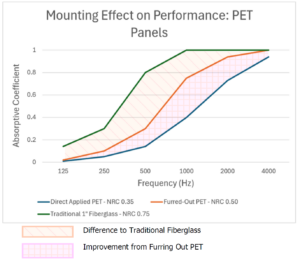
When trying to evaluate if a furred-out panel will get you the performance you need, be on the lookout for the tested mounting method. Type-A is direct attached, and Type D20 has a 20mm airgap behind it.
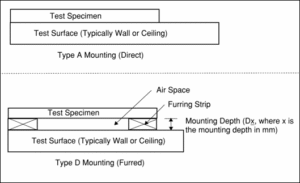
Type A vs Type D Mounting configurations
Bonus: Can I Just Have Them On My Lights?
Another common trend in PET panels lately is to add them to furniture or lighting fixtures. This can help tie the product into a space aesthetically but has mild to negligible acoustic value. Overall, the square footage of material in something like the light pictured below is just not high enough to sufficiently replace typical treatment on the ceiling or wall. Additionally, concentrating treatment as single points instead of evenly spaced over a large surface (such as wall or ceiling) can allow for strange echoes in other portions of the space.
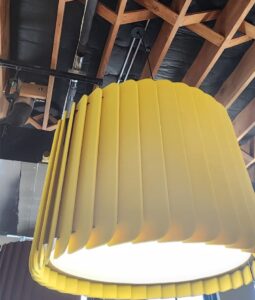
PET Bordered Light: Taken at recently renovated Library
Final Thoughts
PET acoustic panels have earned their popularity for many reasons. They’re attractive, durable, sustainable, and incredibly versatile from a design standpoint. However, architects should be careful not to assume that every PET panel performs like a traditional fiberglass absorber. Just because something is labeled “Acoustic” doesn’t mean it will perform the way you want or expect. With an eye on detail and knowing what you want something to sound or perform like, the right material for the design can easily be found. We work with architects and owners to identify PET panel solutions that balance aesthetics, sustainability, and acoustical performance.
James is an acoustics expert in speech intelligibility for learning and communicating. If you’d like to further PET panels or other panel options, share your thoughts with James and our team of expert acousticians at Tech@NV5.com.