By Tim Waters, CTS, Vice President of the Technology and Acoustics group of NV5
For higher education leaders, integrating IT strategy with capital planning is no longer optional; it’s a strategic imperative. Amid an era of intense budget scrutiny, declining enrollments, fluctuating revenues, and mounting ROI pressure, institutions must modernize infrastructure while mitigating technical debt and resource constraints. Those that adopt agile funding models and collaborative planning will not only navigate uncertainty but lead innovation in a rapidly evolving educational landscape.
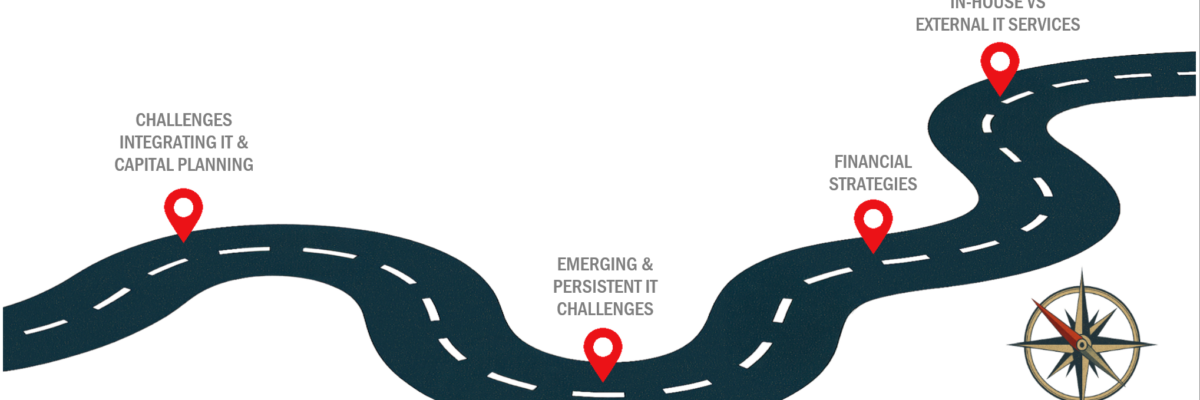
Challenges Integrating IT & Capital Planning
Operating budgets are contracting, often subject to shifting refresh cycles where funding priorities change abruptly from year to year. This volatility makes long-range planning extraordinarily difficult, as multi-year IT initiatives struggle to secure consistent support. Integrating IT needs with capital planning is particularly impacted: facilities projects may advance without adequate infrastructure provisioning, leading to costly retrofits when requirements evolve. Legacy systems, burdened by extensive technical debt, consume outsized maintenance resources, leaving little fiscal flexibility for alignment efforts. Limited staffing further reduces the capacity to participate meaningfully in extended capital planning processes. When revenue dips trigger layoffs or hiring freezes, previously approved initiatives are frequently shelved, disrupting momentum and eroding trust in strategic IT-roadmap commitments.
Emerging & Persistent IT Challenges
Higher education IT departments are confronted with escalating and increasingly interconnected challenges, including the growing need for wireless network capabilities and the significant growth in user expectations for wireless bandwidth, cybersecurity, AI adoption, and hybrid learning support, alongside deeply entrenched issues such as fragmented systems and deferred maintenance. Modernizing or replacing these legacy platforms demands rigorous lifecycle management, extensive training, and meticulous migration planning to minimize disruptions. However, the unpredictable nature of shifting budget refresh cycles undermines long-range planning. Initiatives that seem critical in one fiscal year may lose funding the next, due to revenue shortfalls, causing projects to be halted mid-stream. Layoffs during downturns disproportionately affect already strained IT teams, leaving even fewer resources to maintain services or pursue transformation. This cycle of start-stop progress not only perpetuates technical debt but also hinders the institution’s ability to deliver measurable value to students and faculty, amplifying pressure to achieve more with increasingly constrained means.
Financial Strategies
Financial strategies for IT must prioritize agility and resilience in the face of volatile funding cycles. Quantifying technical debt through metrics on maintenance costs, security risks, and lost productivity remains essential to justify investments, while shifting refresh cycles complicate multi-year commitments. Institutions can mitigate this by adopting structured lifecycle planning that focuses on smaller incremental projects delivering quick wins and demonstrable ROI. These projects are less vulnerable to sudden budget reallocations or revenue-driven layoffs that often derail larger initiatives. Creative funding blends, i.e. combining operational budgets with targeted grants, reserves, or public-private partnerships, provide buffers against fiscal volatility. Closer collaboration between IT, finance, and academic leaders is critical to build flexible business cases that withstand changing priorities. Strategic outsourcing for specialized skills helps address chronic staffing gaps, preserving limited internal resources for high-impact activities while enabling progress on debt reduction even when long-range plans are disrupted.
In-House vs. External IT Services
With operating budgets under sustained pressure and frequent shifts in funding priorities, the decision between in-house and external IT services has become a key lever for institutional resilience. In-house teams offer invaluable campus-specific knowledge and direct alignment with academic missions, but they are highly susceptible to disruption from revenue fluctuations. Layoffs during downturns can decimate institutional memory, while industry turnover already strains retention. The unpredictability of budget refresh cycles further complicates long-range planning, as internal capacity built for strategic initiatives may vanish when projects are shelved amid fiscal tightening. External providers deliver scalable expertise, predictable pricing, and rapid access to emerging capabilities, all advantages that shine when internal headcount is frozen or reduced. Selective outsourcing for routine operations, peak loads, or specialized projects allows institutions to maintain progress on technical debt and transformation goals without relying on volatile internal funding. A hybrid model often proves most effective, retaining a lean core in-house team for oversight, strategy, and change management while leveraging external partners for flexibility. This balanced approach helps universities sustain momentum and deliver ROI even as priorities shift and resources fluctuate.
Ultimately, aligning IT strategy with capital planning enables higher education institutions to move beyond reactive spending and build a more resilient foundation for innovation. Success requires a deliberate and ongoing partnership among IT, finance, facilities, and academic leadership to ensure technology investments are planned, funded, and implemented as part of a unified institutional strategy rather than a series of isolated projects. Institutions that embrace this integrated approach will be better positioned to navigate changing enrollment patterns, evolving student expectations, emerging technologies, and financial uncertainty. In an environment where resources are constrained and the pace of change continues to accelerate, the most successful colleges and universities will be those that view technology not as a cost center, but as a strategic asset that supports their mission, enhances the student experience, and creates long-term institutional value.
Tim Waters is the Vice President of the Technology & Acoustics group of NV5, with more than 30 years of experience in the Audiovisual industry.